

Updated November 2026
In 1996 Bill Gates published an essay on Microsoft’s website called “Content is King”. His argument was simple: the internet would reward the people who made useful information and entertainment, much as broadcasting had. Thirty years on, the phrase is a cliché, and yet the argument has never been more true. What has changed is who reads your content first. Today it is often not a person but a search engine or an AI assistant deciding whether your page deserves to be shown, summarised or quoted.
The numbers make the point. Content Marketing Institute’s 2026 research found that almost every B2B marketer (95%) now uses AI tools in their work, yet only about one in eight rates their marketing as highly effective. More content is being produced than ever; very little of it earns attention. In healthcare the stakes are higher still: WebFX’s study of more than 130,000 health searches found that 51% now trigger a Google AI Overview, the highest rate of any industry.
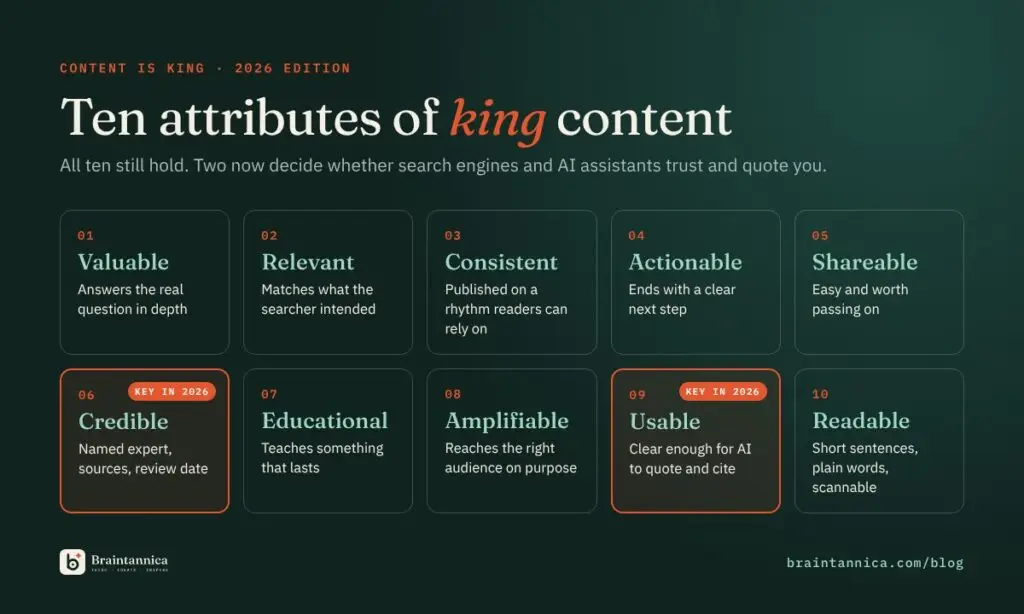
So what makes content worthy of the crown? Here are the ten attributes I use, updated for 2026. All ten still hold. Two of them, credible and usable, have become the difference between being quoted and being ignored.
1. Valuable
Valuable content answers the reader’s real question, fully. That starts with knowing who the reader is. For a hospital’s international team, the reader might be a family in Nairobi comparing knee-replacement options, or a referral partner in Dhaka who needs a quick cost range. Write for one of them at a time.
Pro tips: research what already ranks and cover what it misses; back every claim with a source or your own data; link to credible further reading.
2. Relevant
Relevance means matching what the searcher intended, not just the words they typed. Someone searching “cost of bypass surgery in India” wants a range, what it includes and what changes it. A page that opens with the hospital’s history is relevant to the hospital, not the reader. If people land and leave, your content has missed the intent.
Pro tips: never use clickbait headlines; write a title and meta description that promise exactly what the page delivers; use readable URLs and descriptive image alt text.
3. Consistent
Consistency is a rhythm readers and search engines can rely on: a steady publishing cadence, a consistent voice and depth on the topics you want to own. I still like the phrase “an inch wide and a mile deep”. Ten thorough pages on one specialty beat a hundred thin pages on everything.
Pro tips: pick three to five topic clusters; plan a realistic cadence (two strong posts a month beats eight weak ones); look at what already ranks for a topic and write what is missing.
4. Actionable
Every piece of content should leave the reader with a next step: book a teleconsultation, download a checklist, share reports for a cost estimate, subscribe. Match the ask to the stage of the journey. Early readers want to learn, not be sold to; readers comparing options want specifics, timelines and a named person to talk to.
5. Shareable
Great content that nobody sees is worthless. Shareable content meets two tests: people want to pass it on, and it is easy to pass on. In medical value travel, much of that sharing happens privately, in WhatsApp groups and family chats. A short, clear explainer or a one-page cost guide travels much further there than a long article.
Pro tips: make a shareable version of every major piece (a short video, a one-page summary, an infographic); repurpose each piece across your channels instead of posting once and moving on.
6. Credible
Google applies its highest standards to health and money topics, which it calls “Your Money or Your Life” content. Its guidance asks whether content shows experience, expertise, authoritativeness and trust (E-E-A-T), and in March 2024 it folded its “helpful content” system into its core ranking, so unhelpful, unoriginal pages now pull a whole site down rather than just themselves.
For a hospital this is good news, because credibility is something you genuinely have. Show it.
Pro tips: name the doctor who wrote or reviewed every clinical page, with credentials and registration details; add a “last reviewed” date; cite guidelines and studies; keep facts (fees, accreditations, outcomes data) accurate and verifiable. In India, the National Medical Commission’s October 2026 advertising guidelines also rule out promotional patient testimonials and unverifiable “best” claims, so build trust with verifiable facts instead.
7. Educational
Educational content teaches something that lasts: how a procedure works, how to prepare for treatment abroad, what questions to ask a surgeon. It has a far longer shelf life than news, and it builds the trust that brings readers back when they are ready to decide.
Pro tips: write evergreen “how to” and “what to expect” guides; add short doctor-led videos; review and update your best evergreen pages at least once a year.
8. Amplifiable
Never let good content sit still. Amplification means getting it in front of the right audience on purpose, not spraying it everywhere and hoping.
Pro tips: group your audience by interest and country; use remarketing to follow up with people who read a specific guide; invite questions and reply to comments; keep share buttons visible but unobtrusive and avoid pop-ups.
9. Usable
Usable once meant fast, mobile-friendly and easy to navigate. It still does. But usable now also means easy for an AI system to understand and quote. When an AI Overview appears, fewer people click: Seer Interactive found organic click-through rates on such searches fell by about 61% between mid-2024 and late 2025. The same study found that brands cited inside the AI Overview earned noticeably more clicks than those that were not.
Pages get cited when they answer clearly and specifically. Pages that are vague, padded or hide the answer get skipped.
Pro tips: answer the main question in the first two or three sentences; use clear headings that match real questions; include specifics (ranges, timelines, steps); add an FAQ section; keep pages fast on mobile.
10. Readable
Finally, write for a tired reader on a small screen, often in their second language. Short sentences, plain words, one idea per paragraph and generous headings. Explain medical terms the first time you use them. If an international patient’s family can follow it, so can a search engine.
The bottom line
Gates was right: content is still where the value is. But the crown now goes to content that is genuinely useful, demonstrably credible and clear enough to be quoted. Write for people first, prove your expertise, and make your answers easy to find.
Try this week
- Score your five most-visited pages against the ten attributes above.
- Add a named doctor reviewer and a “last reviewed” date to every clinical page.
- Rewrite the first paragraph of each page so it answers the main question directly.
Sources
- Content Marketing Institute, B2B Content and Marketing Trends: Insights for 2026
- WebFX, AI Overviews in healthcare: a study of 130K+ health queries
- Seer Interactive, AIO impact on Google CTR, September 2025 update
- Google Search Central, Creating helpful, reliable, people-first content
- Google Search Central Blog, March 2024 core update and spam policies