

Updated November 2026
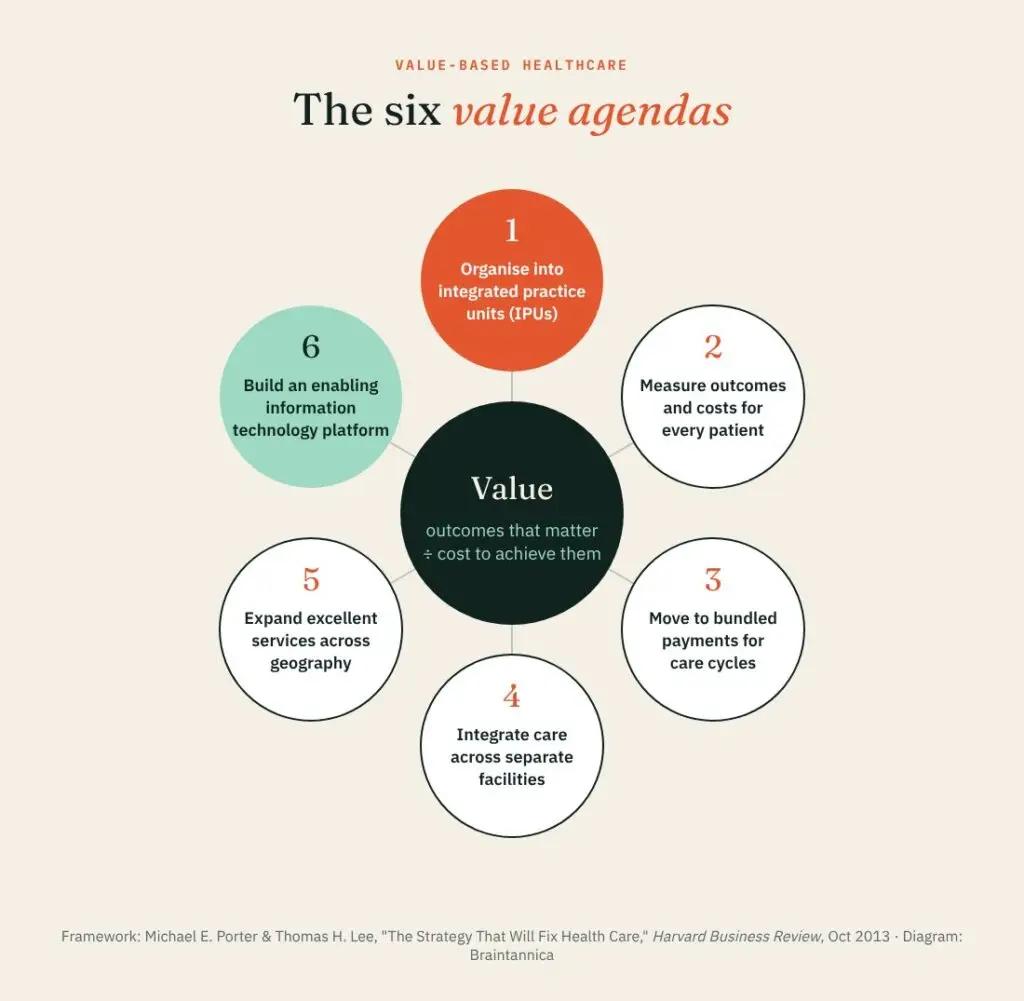
In 2013 Michael Porter and Thomas Lee argued in the Harvard Business Review that healthcare systems everywhere share the same problem: rising costs and uneven quality, despite the efforts of dedicated clinicians. Their answer was to organise everything around one goal, value for patients, defined as the health outcomes achieved per unit of money spent. They set out six interdependent components, which they called the value agenda. Below is my summary of each, with what it means in practice for a hospital, and particularly for one that serves international patients.
1. Organise care around conditions: Integrated Practice Units
The idea: instead of organising by department (radiology, surgery, physiotherapy), organise a dedicated team around a medical condition, such as knee osteoarthritis or breast cancer, covering the full cycle of care from diagnosis to rehabilitation.
In practice: a “joint replacement unit” where the orthopaedic surgeon, anaesthetist, physiotherapist, nurse coordinator and dietitian work as one team, ideally in one place, with one patient pathway. For an international patient this is what a seamless experience feels like: one team, one plan, no hand-offs that the patient has to manage.
2. Measure outcomes and costs for every patient
The idea: value cannot improve if it is not measured. Outcomes should be tracked per condition, across the full cycle of care, and should include what matters to patients (recovery, function, return to work), not just survival. Costs should be measured across the whole cycle too, ideally using time-driven activity-based costing.
In practice: start with three outcome measures per priority condition and report them every quarter. International organisations such as ICHOM publish standard outcome sets that make this easier. Published outcomes are also the strongest marketing asset a hospital can own, especially for patients comparing countries.
3. Move to bundled payments for care cycles
The idea: pay for a complete episode of care at a single price, with the provider responsible for avoidable complications, rather than paying for each test and day separately.
In practice: MVT already works this way. An international package price for a knee replacement, covering surgery, stay, implant and physiotherapy, is a bundled payment. The discipline is to define inclusions and exclusions clearly, price for real costs and outcomes, and honour the bundle when things don’t go to plan.
4. Integrate care delivery across separate facilities
The idea: hospital groups should stop offering every service everywhere. Instead, concentrate complex volume where outcomes are best, move routine care to lower-cost settings, and coordinate across sites.
In practice: a multi-hospital chain might concentrate transplants and complex oncology at one or two centres, run day-care procedures elsewhere, and use shared records so a patient can move between sites without repeating tests.
5. Expand geographic reach
The idea: excellent providers should extend their reach, through partnerships, satellite clinics, telemedicine and referral networks, so that more patients benefit from their expertise.
In practice: this is the strategic heart of Medical Value Travel. Reach can mean outreach clinics in source countries, tele-consultations before travel, follow-up care with partner doctors after the patient goes home, and training partnerships with local hospitals. Done well, the patient travels only for the part of care that truly needs the centre of excellence.
6. Build an enabling information technology platform
The idea: the other five components need IT that is organised around the patient and the condition, not around departments and billing: common data definitions, records that follow the patient across sites, and systems that can report outcomes and costs.
In practice: for international patients this means one shared record from the first enquiry to the last follow-up, secure sharing of reports with referring doctors, and dashboards that track the whole journey from enquiry to outcome.
Where to start
Porter and Lee stress that the six components reinforce each other, but no hospital adopts them all at once. My advice: pick one condition where you are already strong, build an integrated team around it, measure its outcomes and costs, and offer it as a clear bundled package to patients near and far. That single pilot will teach you more about value-based care than any strategy document.
Try this week
- Score your hospital 1–5 on each of the six agendas.
- Pick the agenda closest to your international-patient work, usually ‘expand geographic reach’.
- Write one 90-day project for it.
Sources: Michael E. Porter and Thomas H. Lee, “The Strategy That Will Fix Health Care,” Harvard Business Review, October 2013. ICHOM (International Consortium for Health Outcomes Measurement) standard sets, ichom.org. The framework is Porter and Lee’s; the summary and examples are mine.