
Updated November 2026
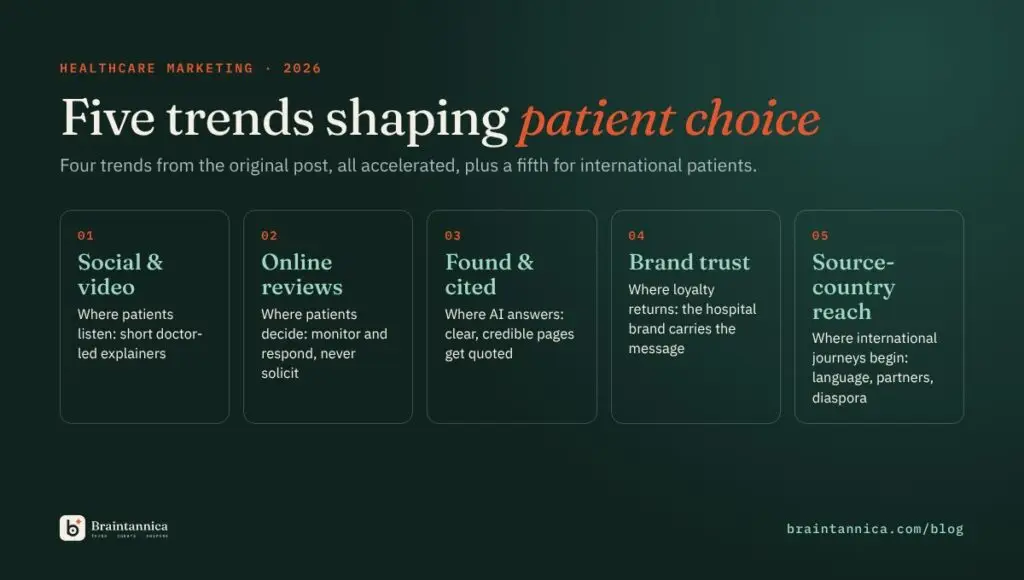
Healthcare marketing keeps changing, and marketers have to keep their finger on the pulse. When I first wrote this post I named four trends: social media, online reviews, engaging content and brand renewal. All four have accelerated. Two things have also changed the rules of the game: AI now sits between patients and providers, and in India the National Medical Commission (NMC) has tightened what hospitals and doctors may say in public. Here is the updated picture, with a fifth trend for anyone marketing to international patients.
1. Social media and video: where patients listen
Patients research health online long before they call anyone. They watch doctor explainers, read posts in condition-specific groups and ask questions in WhatsApp communities. rater8’s 2026 Patient Choice Report, a survey of about 1,000 US adults, found that 47% now use AI tools to research or find a provider, up 16 points in a year. Social media still shapes what those tools and patients see.
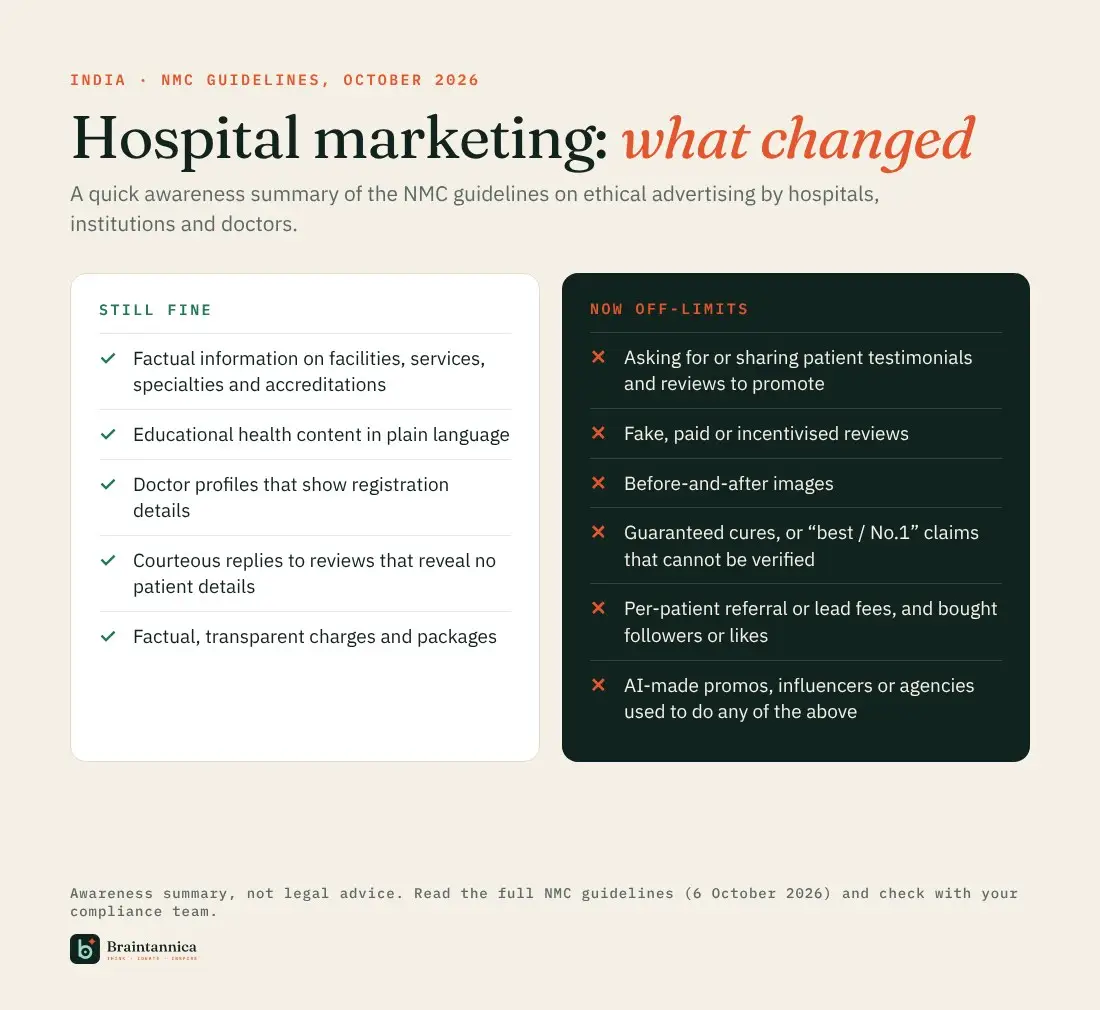
What works now is short, doctor-led, educational video: what a procedure involves, how long recovery takes, what to ask before travelling for treatment. What no longer works in India is self-promotion. The NMC’s 2023 professional conduct regulations already barred doctors from soliciting patients, and its October 2026 advertising guidelines extend clear rules to hospitals and to the agencies and influencers they work with (more on this below).
2. Online reviews: where patients decide
Reviews have gone from influential to decisive. In rater8’s 2026 survey, 75% of patients said they would not book with a provider rated below 4.0 stars, and 55% had avoided or cancelled an appointment because of reviews, up from 40% a year earlier. Its earlier research found that 84% of patients check reviews before choosing a provider.
In India, however, the rules on reviews have tightened. The NMC’s October 2026 guidelines prohibit doctors and hospitals from soliciting, buying or publishing fake, paid or misleading reviews, and from using patient testimonials for promotion. So the job has changed from generating reviews to earning and managing them:
- monitor what patients say across Google and other platforms;
- reply courteously to every review, positive or negative, without revealing any patient information;
- treat negative reviews as free service-quality feedback and fix the underlying problem;
- never buy reviews, incentivise them or reuse them in advertising.
3. Content that gets found and cited
Health information is among the most personal things people search for, and it is now where AI is most active. WebFX found that 51% of health-related Google searches trigger an AI Overview, and Seer Interactive found that clicks on organic results fall sharply when one appears. Pages that answer clearly, cite sources and show a named expert reviewer are the ones these systems quote.
The old advice still holds: write for patients in everyday language, keep clinical depth for the doctor-facing material, and add FAQs. The new advice is to be the source AI trusts. Name the reviewing doctor, date each review, keep facts verifiable and answer the main question in the first few lines. The NMC guidelines also allow hospitals and doctors to publish charges and packages as long as they are factual, transparent and not misleading, so clear cost guidance is now both helpful and compliant.
4. Brand trust: where loyalty returns
Nobody plans where they would like to have a heart attack. But when a health problem does arrive, you want your hospital at the top of the patient’s mind, and you want them to trust it. That trust is built over years through consistent care, clear communication and the experience of every patient and family who walks through the door.
With individual doctors now limited in how they can promote themselves, the hospital brand has to carry more of the message, through factual information about facilities, specialties, accreditations and outcomes data where it can be verified. Several channels still matter as much as ever:
- Referrals: relationships with referring doctors and partner clinics remain one of the strongest sources of patients. Note that the NMC guidelines bar per-patient referral and lead-generation fees, so build these partnerships on clinical collaboration and service, not commissions.
- Your website: still the place every other channel points to. It must be fast, mobile-friendly and clear.
- Newsletters and email: regular, useful health information keeps your hospital in mind between episodes of care.
- Patient reminders and follow-up: good for patients and good for loyalty.
5. Source-country reach: where international journeys begin (new)
For medical value travel, the decision usually starts far from the hospital. Diaspora networks, local-language content, partner clinics and doctors in the patient’s home country shape choices long before anyone books a flight. Hospitals that invest in a real presence in their key source countries (content in local languages, trusted local partners, tele-consultations, and visible follow-up care after the patient returns home) will win the trust that advertising alone cannot.
The bottom line
Patients are better informed and more empowered than ever, and regulators expect healthcare marketing to stay honest. The winners in 2026 will be the hospitals that educate rather than promote, earn their reviews rather than chase them, and make their expertise easy for both people and AI to find. As before, choose a marketing team that understands both the reach and the rules.
This post is for general awareness and is not legal advice. Read the NMC guidelines in full and check with your compliance team before changing your marketing.
Try this week
- Audit your website and social channels against the NMC checklist above and remove anything off-limits.
- Reply to every Google review from the last 90 days, good and bad, without sharing patient details.
- Publish one short doctor-led educational video in a source-country language.
- Track where international patients say they first heard of you.
Sources
- rater8, 2026 Patient Choice Report; earlier finding (84% check reviews) reported by Medical Economics
- South First, NMC says no to patient testimonials, paid ads, AI promotions and “guaranteed” claims (October 2026)
- South First, NMC bars patient referral commissions, restricts discounts and paid rankings (October 2026)
- Medical Dialogues, NMC issues ethical advertising and public communication guidelines
- WebFX, AI Overviews in healthcare; Seer Interactive, AIO impact on Google CTR