

Published November 2026
India has just rewritten its visa rulebook, and medical travel is one of the clearest winners.
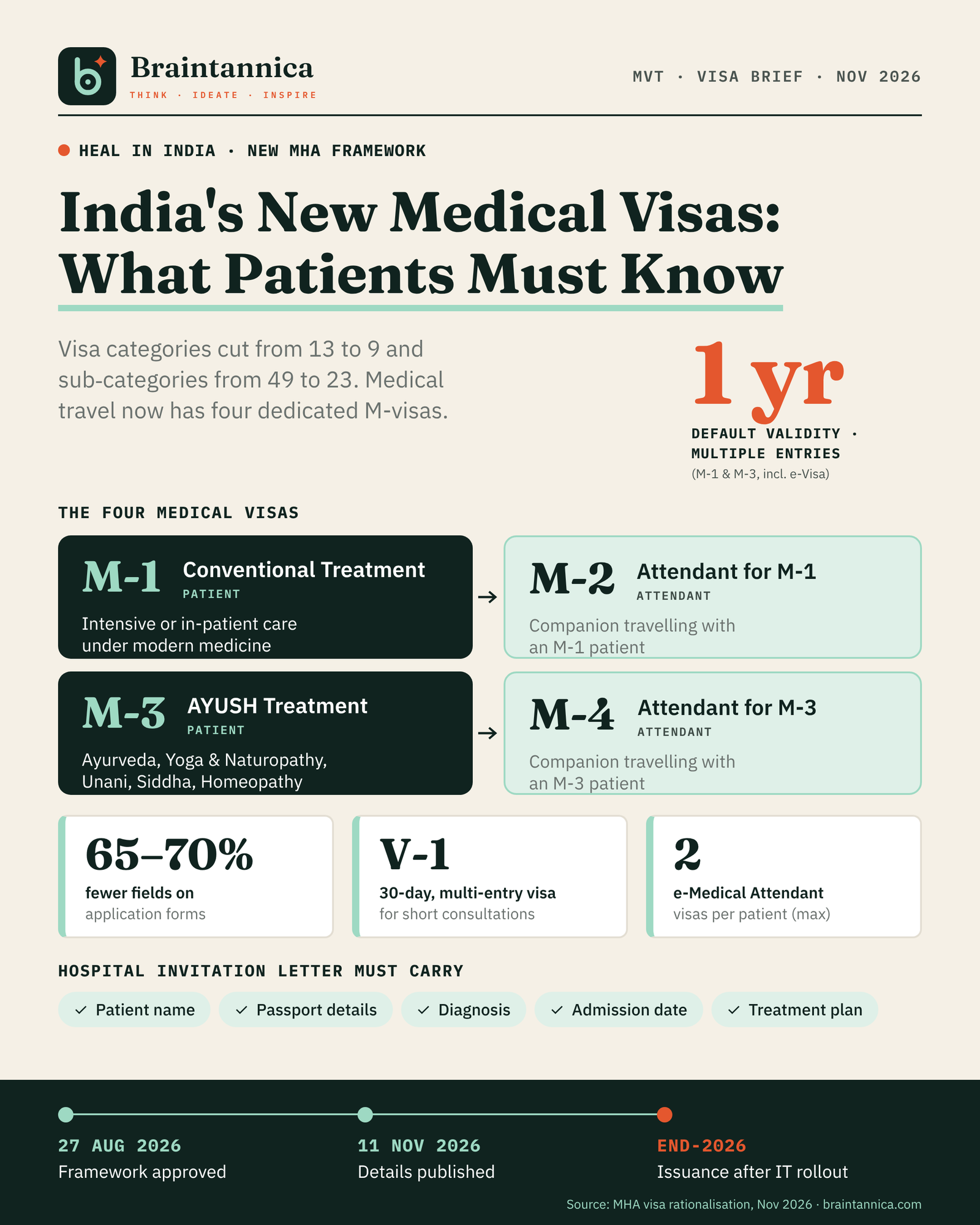
On 11 November 2026, the Ministry of Home Affairs (MHA) published the details of a rationalised visa framework. Main visa categories drop from 13 to 9, and sub-categories from 49 to 23. This is the second round of simplification in just over a year. The October 2025 round had already cut main categories from 22 to 13 and sub-categories from 63 to 49.
For anyone in Medical Value Travel (MVT), the headline is simple. Medical travel now has four dedicated visas, and the default terms for patients are noticeably more generous. The government has linked the change directly to the “Heal in India” vision of making India a preferred destination for treatment.
I have spent most of my career building international patient business for Indian hospitals across the GCC, Africa, SAARC and CIS markets, so I read this one closely. In this post I cover what has changed, why it matters clinically and commercially, what stays the same for now, and what international patient teams should do before the new visas go live.
The bigger picture: fewer categories, clearer choices
Under the revised framework, India’s visa system runs on nine main categories: Business, Diplomatic, Work, Journalist, Medical, Official, Student, Visitor and Miscellaneous.
The aim is to remove overlapping categories so that applicants can pick the right visa for their purpose of travel without guesswork. For international patients, that matters more than it might seem. In my experience, a wrong visa choice at the start is one of the most common reasons a treatment plan slips. A patient applies on the wrong category, the hospital has to re-issue documents, and the admission date moves. A cleaner structure reduces that risk for patients, families and the partners who advise them.
The four medical visas
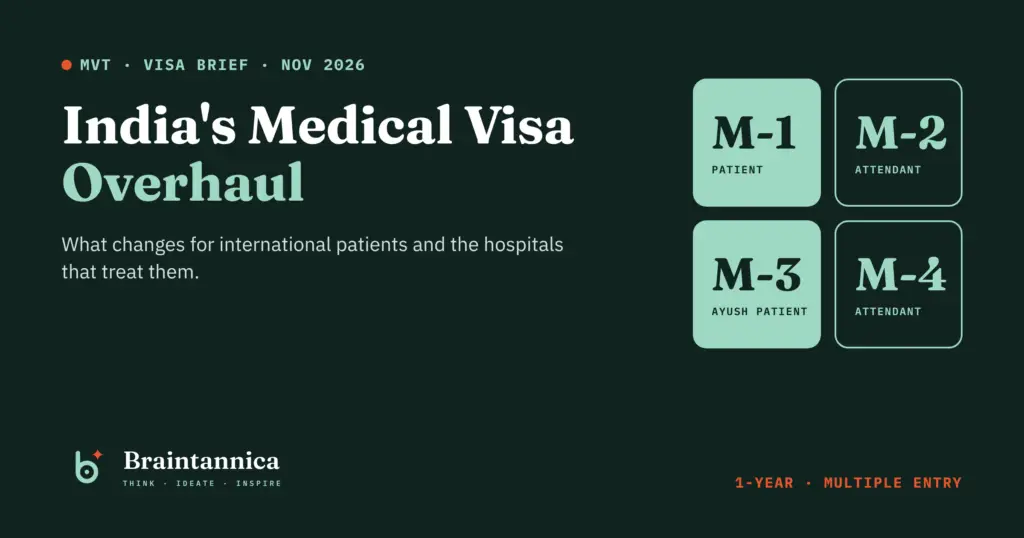
The new framework keeps conventional medicine and AYUSH in separate lanes, each with its own attendant visa:
- M-1: Conventional treatment. For patients coming for intensive or in-patient care under modern medicine: cancer care, transplants, cardiac surgery, joint replacements, neurosurgery and similar treatments.
- M-2: Attendant for an M-1 patient. For the family member or companion travelling with an M-1 patient.
- M-3: AYUSH treatment. For patients seeking care under Ayurveda, Yoga & Naturopathy, Unani, Siddha or Homeopathy.
- M-4: Attendant for an M-3 patient. For the companion travelling with an M-3 patient.
Two things stand out. First, every patient visa now has a clearly paired attendant visa, so families no longer need to work out which category a companion falls under. Second, AYUSH gets its own patient and attendant visas. That is a clear signal that the government sees traditional medicine and wellness as a distinct market, not an add-on to conventional care.
What changes for international patients
1. One year, multiple entries, by default
M-1 and M-3 visas, including their e-Visa versions, will be granted for one year with multiple entries as the default option. This is the single most important change for patients, and I explain why in the next section.
2. Shorter application forms
Required fields in visa application forms are cut by 65–70% across all 23 categories and sub-categories. Overlapping and repetitive questions are removed. For a patient who is unwell, or a family member filling in forms on their behalf, often in a second language, this is a real relief. It also means fewer errors and fewer rejected applications because of avoidable mistakes in the form.
3. Clear provision for attendants
Under the e-Visa guidelines, a patient can be accompanied by up to two attendants on e-Medical Attendant visas. Attendants apply separately, referencing the patient’s case, with their own passport bio-page and photograph.
4. A lighter option for short visits: the V-1 Visitor visa
The new V-1 Visitor visa is granted for 30 days with multiple entries. It covers tourism, business meetings, medical consultations, wellness retreats and short-term medical treatment. In practice, a patient coming for a second opinion, a diagnostic work-up or a short day-care procedure may not need a full medical visa at all.
Choosing the right visa: a quick guide
| Patient situation | Likely visa |
|---|---|
| Second opinion, consultation or diagnostic work-up; short visit, no admission | V-1 Visitor (30 days, multiple entries) |
| Short wellness retreat or brief treatment without in-patient care | V-1 Visitor |
| Surgery, cancer treatment, transplant or other in-patient care under modern medicine | M-1 for the patient; M-2 for attendants |
| Ayurveda, Unani, Siddha, Homeopathy or Yoga & Naturopathy treatment | M-3 for the patient; M-4 for attendants |
| Staged treatment with planned review visits over several months | M-1 or M-3, using the one-year multiple-entry validity |
This is a practical guide, not legal advice. The final category depends on the official criteria and the patient’s treatment plan, so always confirm on the official Indian visa portal.
Why the one-year, multiple-entry visa matters
Most of the patients I deal with don’t make just one trip. Complex care rarely fits into a single visit:
- Oncology: surgery, then chemotherapy or radiotherapy cycles, then scans and reviews over many months.
- Transplants: donor and recipient evaluation, the transplant itself, then close follow-up to monitor rejection and medication.
- Orthopaedics: staged procedures such as bilateral joint replacements, then physiotherapy checks.
- Cardiac care: intervention or surgery, then rehabilitation and periodic reviews.
Every return trip used to carry the risk of fresh paperwork and another wait. That friction has a real cost. Some patients delay follow-ups, some switch to a local provider halfway through treatment, and some never come back for the review that would have caught a complication early.
A visa that is valid for a year and allows multiple entries removes much of that friction. It lets hospitals plan follow-up schedules around clinical need rather than visa dates. It also strengthens continuity of care, which is good for outcomes and good for the long-term relationship between the patient, the referring partner and the hospital.
For hospitals: the invitation letter matters even more
The hospital’s invitation letter, issued on its letterhead, is central to the medical visa application. It must carry:
- the patient’s name, exactly as on the passport
- passport details
- the diagnosis
- the tentative admission date
- the treatment plan
With much shorter application forms, the supporting documents carry more weight. A complete, consistent letter means a faster, cleaner visa decision. A letter with a misspelt name, a missing passport number or a vague treatment plan can hold up the patient and every attendant whose application references that case.
From what I have seen across teams, the most common problems are avoidable: names that don’t match the passport, admission dates that have already passed by the time the application is reviewed, and treatment plans that say “evaluation and management” without any detail. A simple checklist and a second pair of eyes before the letter goes out fixes most of them.
A note on timing: nothing changes overnight
The MHA approved the rationalised framework on 27 August 2026 and published the details on 11 November. Visas under the new categories will be issued only once the Ministry completes its IT rollout, which is expected by the end of 2026.
Until then, the current process applies. Patients travelling in the next few weeks should apply under the existing rules, and teams should be careful not to promise the new terms before they are live. The right message for patients today is: “The new rules are coming soon; for your trip now, here is what applies.”
What this means for source markets
The impact will not be the same everywhere. A few early observations from the markets I work with:
- Markets with long-term, complex cases (oncology and transplant referrals from parts of Africa, the Middle East and Central Asia) gain the most from one-year multiple-entry validity, because their patients typically need staged care and reviews.
- Near markets such as SAARC, where many patients come for consultations and short procedures, will find the V-1 Visitor visa a simpler route for shorter visits.
- Facilitators and information centres will need to re-train their teams, because advising on the right visa from day one becomes part of their value to the patient.
- Government and institutional sponsors who send patients under treatment-abroad programmes will benefit from fewer repeat applications for follow-up visits.
What international patient teams should do now
- Update invitation letter templates so that every letter carries all five required details in a consistent format, with a final check against the passport before it is issued.
- Refresh attendant guidance for patients and families: who applies under M-2 or M-4, what they submit, and the two-attendant cap on e-Medical Attendant visas.
- Brief source-market partners (facilitators, information centres, referring doctors and embassies) so they advise patients on the right visa from day one, including when the V-1 is enough.
- Rework follow-up planning to make full use of one-year, multiple-entry validity for staged and long-term care. Build the review schedule into the treatment plan from the first consultation.
- Prepare for the switchover. Keep the current process running, plan to move templates and partner briefings on the day the new visas go live, and nominate one person to track the MHA rollout.
- Measure the effect. Track visa turnaround times, follow-up completion rates and repeat visits before and after the change. If the new framework works as intended, these numbers should move.
Frequently asked questions
When can patients apply under the new categories?
Only after the MHA completes its IT rollout, which is expected by the end of 2026. Until then, the current visa process applies.
Do the new rules apply to e-Visas?
Yes. The one-year, multiple-entry default covers M-1 and M-3 visas, including their e-Visa versions.
How many attendants can travel with a patient?
Up to two attendants on e-Medical Attendant visas, each applying separately with reference to the patient’s case.
Does a patient coming only for a consultation need a medical visa?
Not necessarily. The V-1 Visitor visa covers medical consultations and short-term treatment for up to 30 days, with multiple entries.
The bottom line
This is a genuinely patient-friendly reform. Longer validity, multiple entries, shorter forms and clearer categories remove friction that has held back medical travel to India for years. But a visa only opens the door. Patients still choose a destination on trust, clarity, outcomes and how well they are looked after from the first enquiry to the last follow-up.
Policy sets the opening. Execution decides who benefits from it.
How is your team preparing for the new framework? I would like to hear what you are changing first.
For a fortnightly round-up of developments like this one, read The MVT Pulse.
Sources: Ministry of Home Affairs announcement on visa rationalisation (11 November 2026), as reported by The Statesman and Free Press Journal; e-Medical Attendant and invitation-letter requirements as per the Indian e-Visa guidelines. Always confirm current requirements on the official Indian visa portal before applying.