

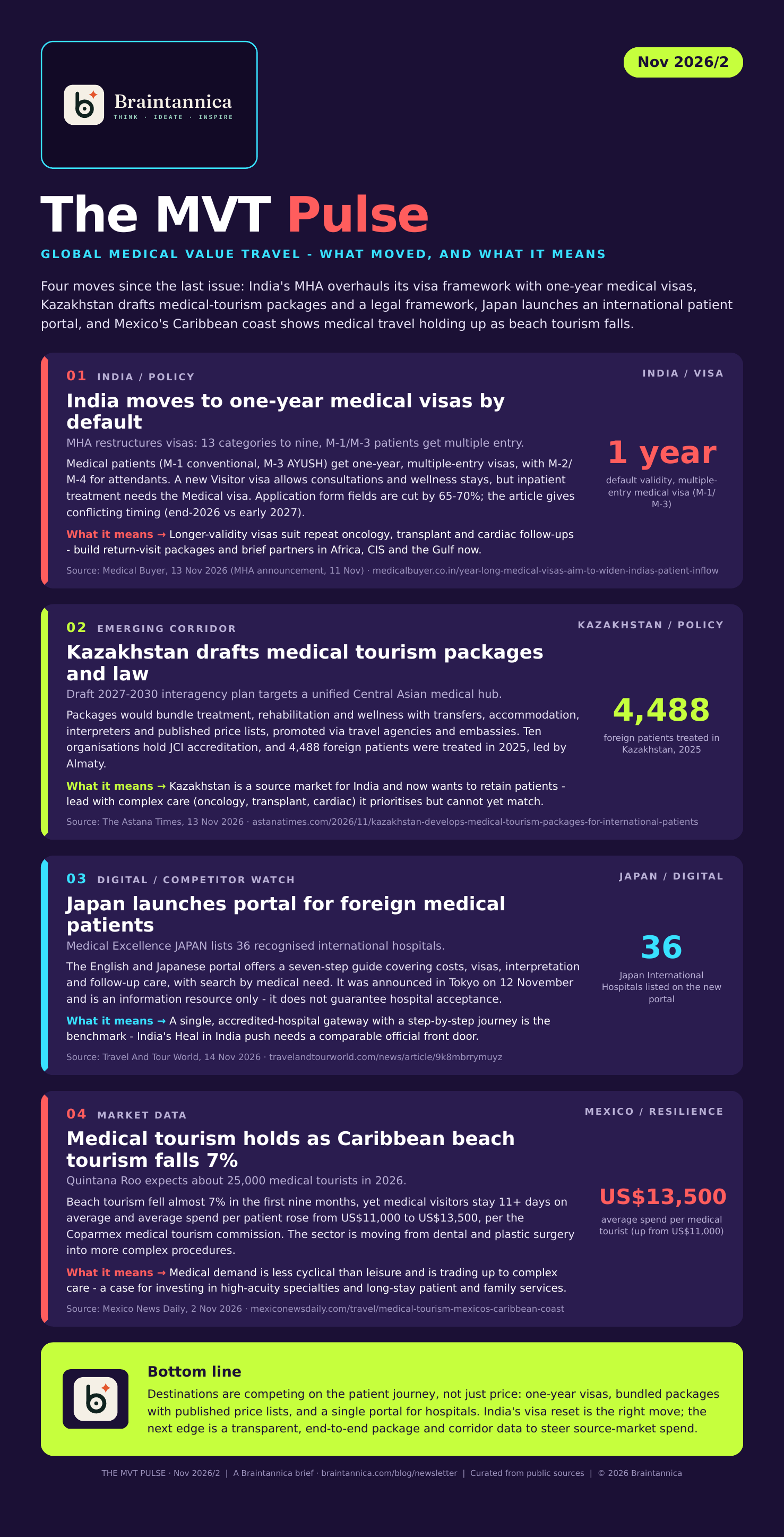
Four moves since the last issue: India’s MHA overhauls its visa framework with one-year medical visas, Kazakhstan drafts medical-tourism packages and a legal framework, Japan launches an international patient portal, and Mexico’s Caribbean coast shows medical travel holding up as beach tourism falls.
01 · Policy · India
India moves to one-year medical visas by default
MHA restructures visas: 13 categories to nine, with multiple entry for medical patients.
1 year — default validity of the multiple-entry medical visa (M-1/M-3)
Medical patients (M-1 conventional, M-3 AYUSH) get one-year, multiple-entry visas, with M-2/M-4 for attendants. A new Visitor visa allows consultations and wellness stays, but inpatient treatment still needs the Medical visa. Application form fields are cut by 65-70%, though the report gives conflicting timing (end-2026 vs early 2027).
What it means → Longer-validity visas suit repeat oncology, transplant and cardiac follow-ups — build return-visit packages and brief partners in Africa, CIS and the Gulf now. For the patient and hospital view, see our explainer on India’s medical visa overhaul.
Source: Medical Buyer, 13 Nov 2026 (MHA announcement, 11 Nov)
02 · Emerging corridor · Kazakhstan
Kazakhstan drafts medical tourism packages and a legal framework
A draft 2027-2030 interagency plan targets a unified Central Asian medical hub.
4,488 — foreign patients treated in Kazakhstan, 2025
Packages would bundle treatment, rehabilitation and wellness with transfers, accommodation, interpreters and published price lists, promoted via travel agencies and embassies. Ten organisations hold JCI accreditation, and Almaty led the 2025 patient count.
What it means → Kazakhstan is a source market for India and now wants to retain patients. Lead with complex care (oncology, transplant, cardiac) that it prioritises but cannot yet match.
Source: The Astana Times, 13 Nov 2026
03 · Digital · Japan
Japan launches an international patient portal
Medical Excellence JAPAN lists 36 recognised international hospitals.
36 — Japan International Hospitals listed on the new portal
The English and Japanese portal offers a seven-step guide covering costs, visas, interpretation and follow-up care, with search by medical need. Announced in Tokyo on 12 November, it is an information resource only and does not guarantee hospital acceptance.
What it means → A single, accredited-hospital gateway with a step-by-step journey is the benchmark. India’s Heal in India push needs a comparable official front door.
Source: Travel And Tour World, 14 Nov 2026
04 · Market data · Mexico
Medical tourism holds as Caribbean beach tourism falls 7%
Quintana Roo expects about 25,000 medical tourists in 2026.
US$13,500 — average spend per medical tourist, up from US$11,000
Beach tourism fell almost 7% in the first nine months, yet medical visitors stay 11+ days on average, per the Coparmex medical tourism commission. The sector is moving from dental and plastic surgery into more complex procedures.
What it means → Medical demand is less cyclical than leisure and is trading up to complex care — a case for investing in high-acuity specialties and long-stay patient and family services.
Source: Mexico News Daily, 2 Nov 2026
The bottom line
Destinations are competing on the patient journey, not just price: one-year visas, bundled packages with published price lists, and a single portal for hospitals. India’s visa reset is the right move; the next edge is a transparent, end-to-end package and corridor data to steer source-market spend.
The MVT Pulse is a free Braintannica brief on global Medical Value Travel, curated from public sources.